

SYNTH-PUNK, INNER DEMONS, AND REBELLIOUS TRUTH FROM THE EASTERN EUROPEAN UNDERGROUND
W: Angie Hills-Jackson
In a world dominated by polished social media feeds and manufactured chart hits, Normal Gergely is building something far more volatile. Under the moniker Belső Ellenség (Hungarian for "Inner Enemy"), the solo artist weaves distorted guitars, 90s synthesizers, and fierce, politically charged lyrics into a raw, uncompromising soundscape. Equal parts visceral synth-punk and deep, multidisciplinary reflection, Belső Ellenség captures the angst of a generation navigating social division, personal warfare, and the weight of history.
We sat down with Gergely to unpack the multi-layered concept behind the name, recording vocals in isolated vans, and why real social change starts inside.
WHO IS BELSŐ ELLENSÉG?
ASBO: Who is Belső Ellenség?
Belső Ellenség: Belső Ellenség is, in many ways, the voice of a generation—the voice of workers, vulnerable people, and a nation that often feels lost.
The concept has two layers. The first is personal: the "subjective self," a young man from Eastern Europe struggling with the society around him, shaped by his social and cultural environment. The second layer presents a broader picture, reflecting on the nation, Europe, and the wider world. The personal experience becomes a way of talking about larger social and political realities.
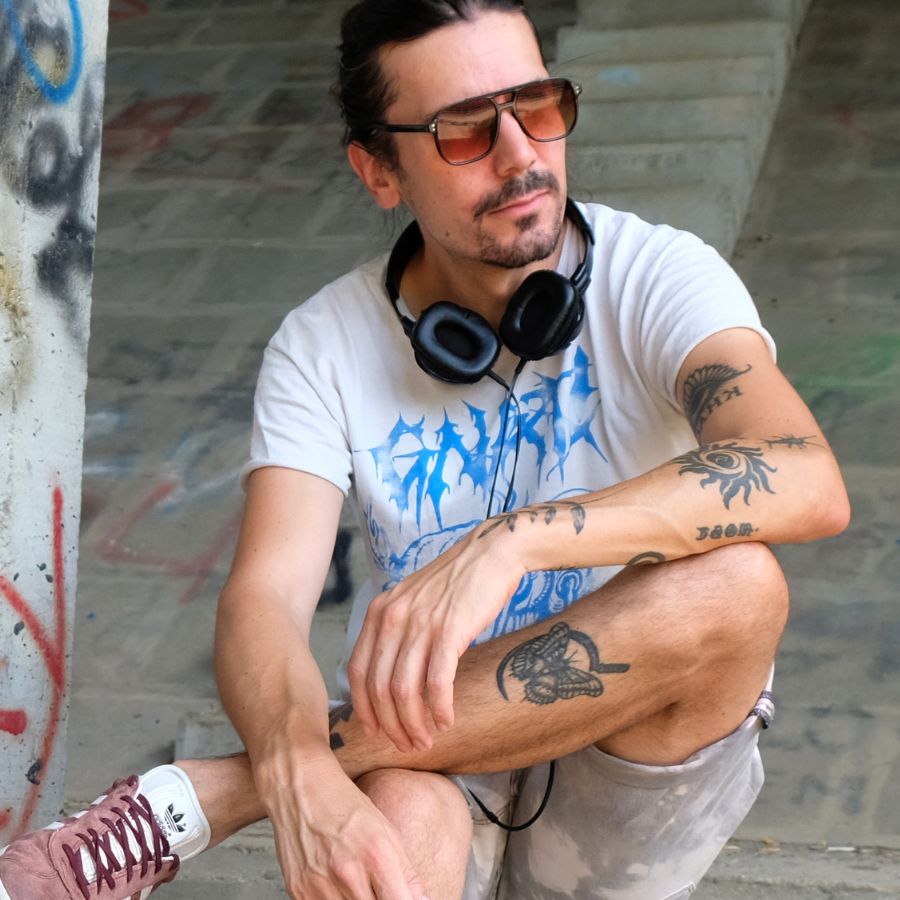
So, who is Belső Ellenség? The answer is: Normal Gergely.
At this point, it’s a one-man project; I don't have a band at the moment. I consider myself an interdisciplinary artist. Different ideas demand different artistic forms, and in this case, it became a music project built around lyrics. My anger is one of the main driving forces behind my art. Since childhood, I’ve created drawings, graphics, and paintings that explore social issues. Belső Ellenség addresses those same subjects through distorted guitars, synthesizers, and rebellious lyrics.
Normal Gergely and Belső Ellenség are almost the same person. This furious energy fuels my creative process—sometimes it becomes visual artwork, other times it takes the form of music.
"My anger is one of the main driving forces behind my art... Belső Ellenség addresses social issues through distorted guitars, synthesizers, and rebellious lyrics."
SOUND & SUBVERSION
ASBO: For someone who is yet to discover you, how would you describe your music?
Belső Ellenség: The simplest answer would be synth-punk, although that label is only a convenient shorthand.
For me, punk is not a genre as much as an attitude, an energy, and a way of thinking. The synth part refers to the electronic side—I use a lot of synthesizers inspired by 1990s instruments. But genres can be misleading. My songs aren't written to be hits. A hit isn't necessarily the best song; it’s simply the one that catches the audience at the right moment. My approach is completely experimental, exploring sounds with childlike curiosity.
Writing has always been just as important to me as music. My texts were previously published in an illustrated poetry book titled Körletellenőrzés (Territory Check). When I combined those sound compositions with my poems as lyrics, Belső Ellenség was born.
The lyrics deal not only with contemporary society but also with personal history. Some songs were inspired by my grandfather's diary from a prisoner-of-war camp, which became one of the key sources of inspiration.
ASBO: What is your pre-show routine? Do you have any diva demands?
Belső Ellenség: I don't play live at the moment—that’s a plan for the future! But when I did gigs, all I needed was a 220V power outlet.
I do have a personal ritual when recording vocals, though: I always record them in my van. I drive out of the city to the edge of a forest or an open field, where I can scream as loudly as I want without disturbing anyone.
OUTSIDE THE MACHINE
ASBO: Where do you feel you fit into the wider music landscape?
Belső Ellenség: Honestly, I don't think I fit into the music industry at all. I have around a hundred listeners, and I'm not interested in becoming part of the machine.
To me, the music business often feels like a dead end. Advertising, management, and social media can easily distract people from what really matters. Sometimes I think we all need a stop button.
Music belongs to everyone. Everyone should have the chance to create it, play it, or simply enjoy it with curiosity and freedom, without fear of making mistakes. If you play guitar or drums every day, you're probably happier than if you don't. Music shouldn't belong only to professionals.
ASBO: Is there a specific story behind the name Belső Ellenség?
Belső Ellenség: Belső Ellenség literally translates to "Inner Enemy," and it carries two main layers of meaning:
- The Political: Throughout history, authoritarian systems have relied on the concept of an "enemy" to divide society and consolidate power. Hungary has experienced this in various forms, and similar rhetoric exists worldwide today.
- The Spiritual: The phrase also appears in Christian thought, representing our own weaknesses, fears, and inner conflicts.
Before we look for enemies outside ourselves, we should first examine what is happening within. You can replace a prime minister, but it is just as important to improve the "prime minister" within yourself. Real social change begins with personal transformation.
RESPONSIVENESS & REFLECTION
ASBO: What would you say is your greatest strength as an artist?
Belső Ellenség: A sense of social responsibility and empathy.
I don't only write my own lyrics; I also draw inspiration from classic Hungarian poets. Hungarians are deeply connected to their literary heritage—many of our streets are named after revolutionary writers whose words helped shape our national identity. Two hundred years ago, these poets were lighthouses for society. Today, people pass their street signs on the way to work, but their revolutionary ideas are rarely discussed.
Art should encourage people to think, ask questions, and reflect on the world they live in. That is the core responsibility of an artist.
ASBO: And your greatest weakness?
Belső Ellenség: Being a complete outsider to the music industry is probably both my greatest weakness and my greatest freedom.
Promoting myself has never come naturally. The constant digital noise is exhausting. I don't want to sell my music like a fishmonger selling fish or a company selling insurance. I hope people discover it because it speaks to them. I earn my living through graphic art and other work so I can keep music separate from money. For me, music is sacred.
"I don't want to sell my music like a fishmonger selling fish... I keep music separate from money. For me, music is sacred."
ROOTS & REVOLUTION
ASBO: Which artists or bands have had the biggest influence on your work?
Belső Ellenség: Curiosity is key—I’m constantly discovering new music across punk rock, experimental electronics, cold Oi!, folk, pop rock, and hip-hop.
As a composer, my influences come from unlikely places: I grew up with 1990s Eurodance, found my anger in punk and hardcore, and shaped my worldview through revolutionary poetry. Mix all of that together, season it with frustration, and keep it on the fire until it explodes—that’s where Belső Ellenség begins.
ASBO: Who would you most like to collaborate with artistically?
Belső Ellenség: I don't have a specific dream collaboration right now. What matters most to me currently is absolute creative freedom.
However, I did release a split album with my friend Terriertex, a Hungarian folk-punk songwriter whose work I strongly recommend. Seeing how another artist solves creative problems differently can encourage you to explore new directions.
LOOKING AHEAD: MADE IN HUNGARY
ASBO: What has been the most difficult obstacle you’ve faced, and how did you overcome it?
Belső Ellenség: Balancing time and money. I work to make a living, but I feel a constant need to create. It feels like living two lives while only having one.
When I get stuck creative-wise, I switch mediums—I move to graphic art, paint, write poems, or pick up a different instrument. And if that doesn't work, I get outside, go for a bike ride, and stop forcing it. Creativity can't be rushed.
ASBO: What’s on the horizon for you, and what can fans expect from the new album, Made in Hungary?
Belső Ellenség: I recently brought my singles together into a full-length album structure on Spotify and YouTube, and I’m hoping to release Made in Hungary on physical CD this year.
Listeners can expect something loud, melodic, rebellious, and surprising. It’s a record that carries bitterness, but actively searches for moments of hope and uplift.
ASBO: What else is currently driving your creative focus?
Belső Ellenség: I like launching distinct projects for different mindsets rather than forcing every idea into one frame. Alongside Belső Ellenség, I created Atomkohó—an abstract, blackened punk project with electronic elements that explores life from a much more surreal and philosophical perspective.
Different ideas need different outlets, and there’s plenty more music on the way.
Stream Belső Ellenség now on Spotify and YouTube, and look out for the physical release of 'Made in Hungary' later this year.