


W:Theo Thompson
By the time Sandy, better known as Dr Banana, reflected upon his younger self, the feeling was almost circular. A loop revolving after years spent tracing the grooves of dance music’s past, present and possible futures. “I think I’d be very excited at the thought,” he spoke softly. “I wouldn’t have considered myself musical enough or artsy enough to do this.” Yet decades on from his first forest rave, he has become one of the UK underground’s most respected curators; a collector, DJ and label head defined not by genre but by spirit, by his own phrase: “miles of different styles.”
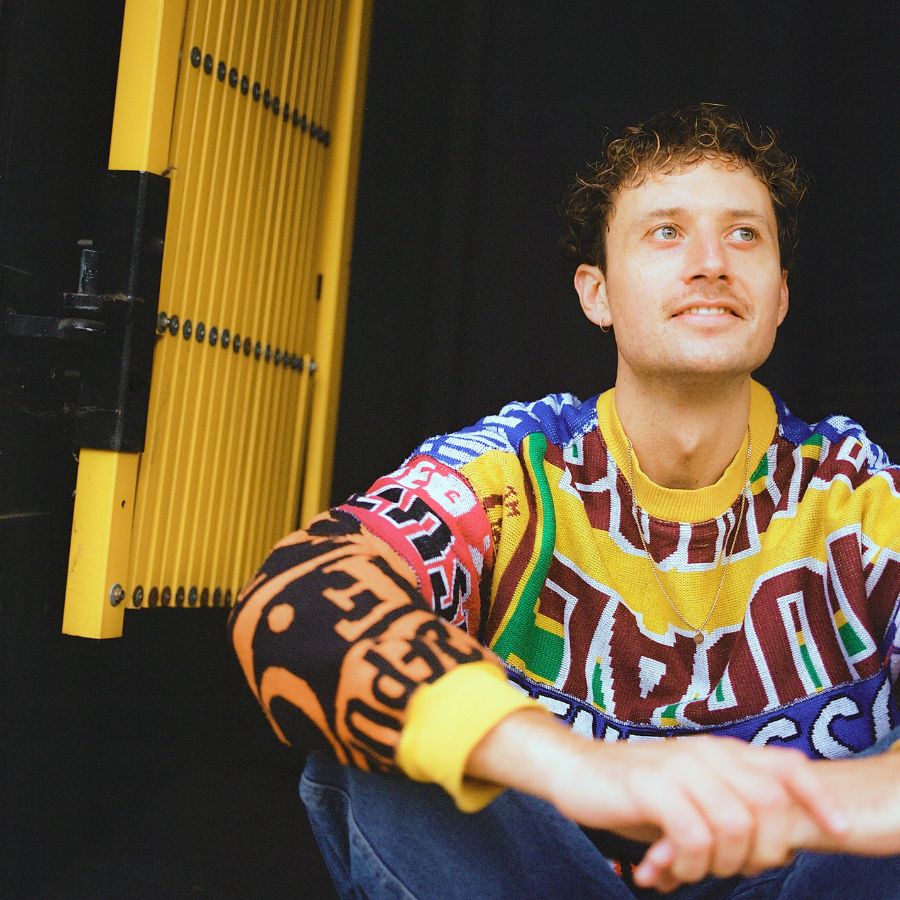
Sandy grew up “in the sticks near Brighton” in a household where music was more cultural backdrop than obsession. His parents’ record collection consisted largely of Elvis and The Beatles. His first encounter with garage emerged through the glossy gateway of pop compilations like Now That’s What I Call Music!, a surprising but formative introduction. “Garage was in the charts,” he recalls. “That’s what gave me a love for it.” Tracks like ‘Body Groove’ by Architects seeped into his teenage imagination; the first sign of a curiosity that would soon become a calling.
That curiosity found oxygen in the rural rave scene. “The free parties in the woods were my introduction to partying, a total vibe,” he laughs. What he discovered there wasn’t just music, but community. A spirit of belonging, rooted in improvisation and shared energy. At that time, drum and bass dominated his attention. “I was obsessed,” he admits. “Didn’t want to hear anything else for a long time.” Yet a warehouse night in Hackney Wick, when he was just sixteen, shifted his trajectory completely: “That first warehouse party massively broadened my perspective musically.” It opened his ears to the breadth of electronic sound; to the strange, the unpredictable, the joyful dissonance between genres.
Sandy’s journey as a collector began around 2011, at a time when UK garage was out of fashion and record prices were modest. “I was buying job lots of garage because I couldn’t afford individual records, 100 records for 50 quid!” he recalls. Some of those £0.50 cuts later became collector’s gold, like DJ Deller’s Romantic Call, which he would go on to reissue years later. His early approach was pure intuition: digging through the unknown, hunting for “records that twist your head a little bit on the dance floor.”
That philosophy of discovery, the thrill of finding something weird and uncategorisable, became the foundation for his later ventures. “I find the best stuff when I look at things I wouldn’t normally.” What began as a habit became an ethos: to listen without prejudice, to dig without boundaries and to share what he found.
The birth of Dr Banana, first as a clothing label then as a record imprint, came almost by accident. “I just wanted a creative outlet,” he says. “Something to do so I didn’t feel like I was just working a dead-end job.” The brand started small, a side project among friends that unexpectedly grew into a full-time pursuit. “It kind of started with clothes being my bread and butter and now the music is what I live off.” The label’s inception was marked by a striking serendipity, unfolding in tandem with the wider revival of UK garage. Its recognisable designs became a symbol of the new wave: cheeky, DIY and deeply rooted in community.
But success brought its own tensions. “Dr Banana was great, it took off just as garage had its resurgence but I started to feel pigeonholed,” he says. His tastes had evolved, his curiosity stretched wider than genre boundaries could hold. The solution came in ‘Styles For Miles,’ a new label built on freedom. “It’s about vibe, not genre,” he explains. “Miles of different styles. Anything that feels right.” The label became a vessel for his eclecticism, a home for house, breaks, hip-hop and a whole array of kindred sounds; for music that moved with the same honesty that guided his own evolution.

Where Dr Banana anchored his legacy, Styles For Miles rekindled the spark of creative hunger that first propelled his artistry. Yet still through all his projects, Sandy remains loyal to the tactile, imperfect beauty of vinyl; a medium he describes as “tangible, imperfect and human.” His love for physical records borders on romanticism: “I remember records by how they look: the sticker, the scuff, the stain.” Each mark, he says, tells a story. “I remember where it is in my collection, the sticker from the last person that owned it, even the footprint from a party. That’s what I love.”
In an era of algorithmic discovery and endless digital archives, this devotion to the tangible feels almost rebellious. “Digital music is so transient,” he notes. “You consume it and it disappears, just more text on a screen.” For him, collecting vinyl isn’t nostalgia; it’s discipline. With finite space, he keeps only what he truly loves; each record an act of curation, each shelf a map of memory.
This sensitivity extends to his reflections on club culture. Sandy speaks wistfully of dance floors before the phone era, when connection was unmediated and no one worried how they looked on camera. “Back then, no one had video phones… dance floors weren’t full of people filming,” he says. “People are more self-conscious now. They’re worried how they’ll look, if it ends up online. It just doesn’t harbour a good atmosphere on dance floors where people are extra conscious of how they’ll be perceived.”
For him, club culture is sacred. A space for release, not performance. That conviction fuels both his artistry and his admiration for scenes abroad, particularly both Ukraine and Georgia, where he finds raving still carries meaning. “It really feels like partying with a bit more of a purpose,” he reflects. “The atmosphere… completely unrivalled. That’s how it should be done. Utmost respect between ravers.”
His experiences abroad have reinforced his belief in the communal heart of dance music and sharpened his critique of commercial pressures at home. He laments the UK’s habit of packing lineups to sell tickets at the expense of artistry: “You want to be seeing people play for at least two hours but generally three or four is ideal. After one hour, you’re only just getting started.” Longer sets, he affirms, allow storytelling; the slow burn of emotion and discovery that first drew him to the decks.
Behind every set lies a ritual of intention. “I’ll visualise it — put a record on and be like, can I see this working in the context of the space ?” he says. “It’s prime real estate in your bag.” His relationship with music remains tactile and deeply considered.
And yet, amid all his thoughtfulness, Sandy’s approach is grounded in humour and humility. “Take the music seriously, but not yourself too seriously,” he laughs. Onstage, that manifests in playful wigs and a light-hearted energy that keeps joy at the forefront. “I like to deliver it with a smile and a bit of fun… in a world where some areas of dance music can feel so serious.”
His words to aspiring DJs encapsulate the guiding principle of his own ascent, a quiet faith in passion and purpose: “Do it because you love it. If it’s meant to be, it’ll just happen.” His evolution from cheap job lot records to marathon sets in Kyiv is a testament to that ethos. There was never a master plan, only persistence and curiosity.
So, what would that teenager at the forest rave think now, seeing his future self command dance floors across continents? Sandy pauses, smiling. “I think he’d be buzzing. We used to look up to the local DJs at those free parties. They were just spinning these local nights, but to us they were the daddies.”
That sense of awe, that innocent thrill of discovery, remains the essence in his story. For all his experience, Sandy still speaks with the same wide-eyed wonder that first pulled him to the dance floor. In a world of trends and algorithms, his journey stands as a quiet manifesto: stay curious, stay human, keep digging for the unknown. Because, as Dr Banana reminds us; the best records, and the best lives, are the ones that twist your head just a little bit.