

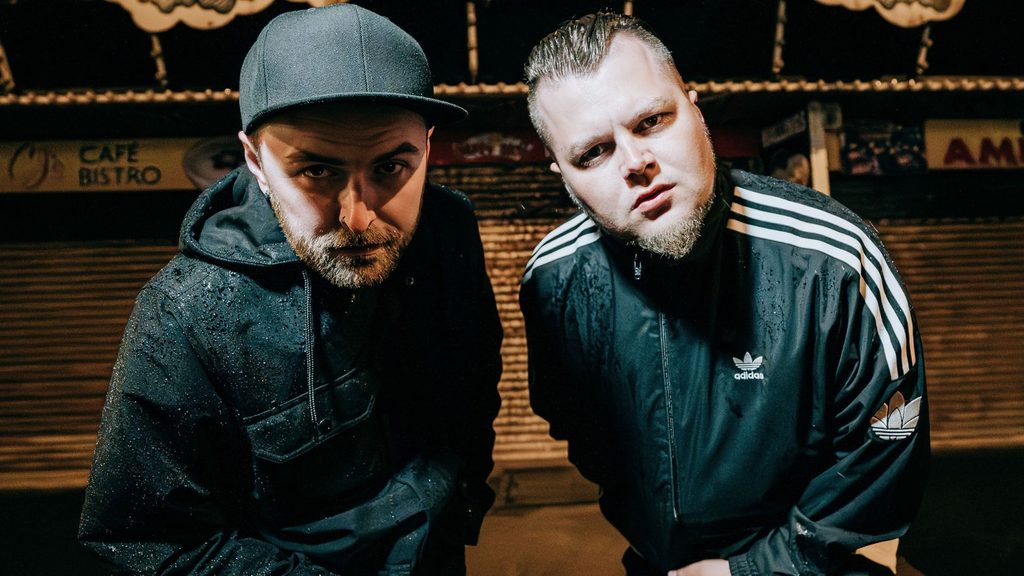
Glasgow alternative hip-hop outfit Hessian Renegade channel generational grief, pub culture, and British malaise on their melancholic new single, 'The Third Place'.
"People are ready to be angry again. Nu-metal is back, dance music is as huge as ever, and hip-hop remains a cultural pillar."
Glasgow’s alternative music underground has long thrived on raw grit, but few acts fuse dark electronic architecture with razor-sharp spitfire verse quite like Hessian Renegade. Comprising frontman Conor on vocal and graphic duties alongside producer Ross sculpting the instrumentals, the duo deliver a sonic kick to the chest they succinctly sum up in three words: Angry Rap Rave.
With their haunting new cut, 'The Third Place' turning heads across the country, we sat down with the pair to talk sociological grief, backstage rituals, and turning devastating setback into creative fuel.
Before stepping on stage, the pre-show energy stays remarkably grounded. Conor sticks to a strict pre-gig ritual of one pint of lager and a can of energy drink, while Ross might indulge in a couple more. "We save the real drinking for later, we’re pretty good boys in all honesty." Conor admits. That discipline feeds directly into their place in today's music landscape. While their sound crosses paths with current revivals in dance, nu-metal, and rap, Hessian Renegade aren't chasing temporary trends. When the current wave of 90s and Y2K nostalgia eventually passes, they'll still be firmly building their own lane.
"The track is about that older generation of men who carried a deep sadness which would often present itself as anger or bitterness."
Their latest single, 'The Third Place' dives deep into the sociological fabric of their hometown. In sociology, a "third place" refers to an anchor space outside of home and work, a role held almost exclusively by the pub for generations of working-class men across Glasgow and the West of Scotland. The track explores the complex legacy of that pub culture, unpacking the toxic masculinity, generational grief, and suppressed emotions of the men they grew up around.
The narrative echoes far beyond local barstools, drawing sharp parallels to the collective psyche of the modern UK: a fallen empire trapped in faded memories of its "glory days", struggling to adapt to a rapidly changing world. Musically, the song is soaked in nocturnal nostalgia, dreamlike, melancholic, and crafted with a progressive intro built specifically for late-night headphone listens.
"It draws parallels to the state of the UK itself, a fallen empire stuck in faded memories of its 'glory days', struggling to adapt to a world that's changed without it."
Operating as a total one-stop shop, the pair handle almost everything in-house. Conor brings his background as a graphic designer to direct all visual branding, while Ross builds the tracks from the ground up, leaving only photography and final mastering to outside hands. That self-reliance extends to how they navigate industry challenges. While navigating modern social media algorithms like TikTok remains an ongoing chore for two guys in their 30s, their biggest trial came early on when a high-stakes track playback at Glasgow's massive Hydro Arena was abruptly pulled due to technical issues. Sitting in the audience devastated, they picked themselves up and kept moving, a milestone failure that now serves as their ultimate metric: "At least it’s not the Hydro."
Looking ahead, the duo's creative focus remains heavily fueled by politics and world events. Their upcoming debut album balances equal parts fury and mourning, pulling inspiration from trip-hop legends like Portishead (whose frontwoman Beth Gibbons sits atop their dream collaborator list) alongside Massive Attack, Cypress Hill, The Prodigy, and Bicep.
"Early in a project, a disappointment like that can finish it. Now when bad things happen, we just say: 'At least it’s not the Hydro.'"
On stage, that political rage transforms into pure live power, especially on Big Beat anthems like 'Neo Pagan', which shakes venues with screaming choruses and rapid-fire verses. Beyond the music, the journey has brought its share of surreal backstage moments, including a memorable encounter where a fan pulled out a knife just to prove he was "about that life" before both ended up sharing a peaceful pint.
.
.