

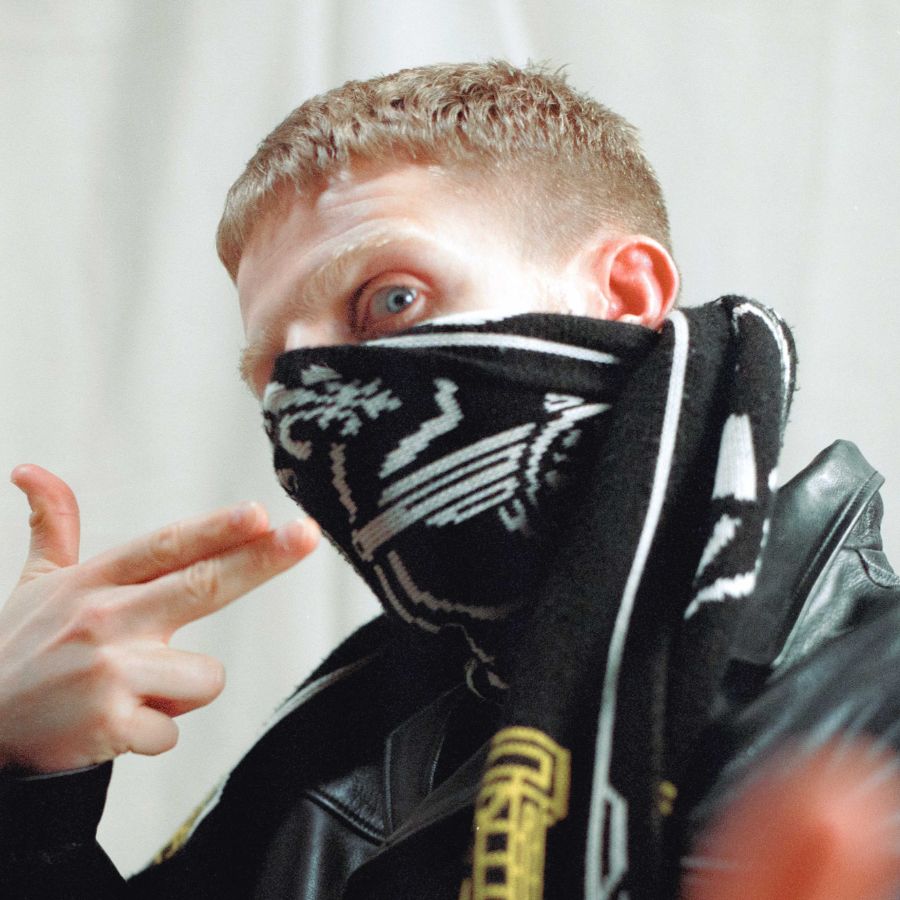
"A London born and bred storyteller chiselling away at the fragments of the capital's underbelly."
W: Mandy Morgan
In the sprawling, often unforgiving concrete expanse of the capital, stories are frequently lost in the noise. However, Truman—the London born and bred artist and poet otherwise known as Charley Palmer Rothwell—is making sure his voice is heard with a visceral clarity. His debut album, Kid Raise Kid, is not just a collection of songs; it is a dark, character-driven expedition into the psyche of a man who had to grow up far too fast.
"From the congregation of the 'Public House' to the chaos of 'Relapse', Truman transforms poet into rockstar."
Produced by the heavyweight Jakwob (whose credits include Little Simz and Nia Archives), the album is a jagged, syncopated universe. Jakwob’s production provides the industrial skeletal frame upon which Truman chisels away at his own history. The result is an unflinching revelation of childhood trauma, the suffocating grip of toxic masculinity, and the raw reality of a working-class upbringing in London’s underbelly.
The album’s title carries a heavy weight. Truman describes the inspiration as the "anger of being a child who was neglected by his nearest... and humiliated like a baby handbag." This is the "shadow" he has befriended—the version of himself he calls "The Kid who Raised the Kid."
"Truman bobs and weaves through a jagged, syncopated universe, landing punchlines with the precision of a prize-fighter."
The journey begins with "Charley Boy," where an unruly, warbling bassline forces Truman’s vocals to bob and weave like a prize-fighter. He lands punchlines and hooks with an actor’s precision, a nod to his established career working with directors like Edgar Wright and Myriam Raja.
As the record progresses, the atmosphere shifts:
- "Beer Knights": A haunting, melancholy track where Truman’s vivid lyrics orbit a dark soundscape.
- "Public House": A rare moment of affection, paying tribute to the "congregation" of the local pub and its role as a secular sanctuary.
- "Relapse": Jakwob introduces shredding guitars, transforming the poet into a rockstar to capture the frantic chaos of a drug-fuelled binge.
- "You Can’t": A clever play on words that allows Truman’s tongue-in-cheek songwriting to shine over up-tempo drums.
Throughout the ten-track body of work, Truman avoids the easy tropes of identity politics. Instead, he opts for nuance and a dark, nihilistic humour. It is an arresting realism that refuses to blink, proving that emotional honesty is the only way to truly face one's contradictions. Kid Raise Kid is a gem mined from the dark—sharp, glinting, and impossible to ignore.